Showing posts with label Preschool. Show all posts

Friday, November 18, 2011

Co-op Preschool

A few moms from our LDS Congregation (ward) started a co-op preschool this year. None of us really have the money to send our kids to a preschool, nor would I really want to – I want to know exactly what is going on with my kids, and exactly who is teaching them. I know the moms pretty well, and our kids have played together for the last year since we moved in. We all have similar standards and I know my kids will be safe learning from them, and being with their children. Plus – once every few weeks, I get to teach them all!

The preschool was really easy for us to form. We met together and made a list of topics we want to cover. Then one of the moms made a schedule for us, rotating houses/moms each week. I put together a box of supplies (crayons, scissors, etc – we mostly all just donated a little of this and a little of that from our own supplies instead of purchasing supplies specifically for the preschool box – it worked out the best and was virtually free). The other mom bought a few posters (a calendar, the alphabet, etc) that we had laminated and put in the box to rotate homes.

Our schedule is really loose, and we’re not picky about anything – it’s preschool after all. We have our preschool on Tuesday and Thursday mornings from 9:30am – 11:30am. We start with circle time where we talk about the calendar and the weather, and sing a few songs. Then we do coloring/activities for a number and a letter. Then we get into the lesson, and do some crafts or games. We also have snack time, then lay down for a few minutes, then we read books and have free play.

It’s pretty low key, and more than anything I think it just helps us feel like we are involved in getting our kids ready for Kindergarten (three of the four start Kindergarten next fall).

My favorite part is that I teach two days, and then I don’t teach again for a few weeks, and I get to send my high-energy four year old off to his friends house for a few hours two days a week. It’s such a fun thing because the kids love each other, and we moms only have to put in two days every four weeks or so. Basically the return on investment is very very high. I’m loving it!

Do you send your kids to preschool? Do you co-op with other moms? Do you just do it yourself at home? What kinds of things are you working on with your kids to get them ready for Kindergarten?

Thursday, November 17, 2011

Scrubbits

IMG_0895

Meet a Scrubbit!

IMG_0898This week in our co-op preschool we have been learning about personal hygiene. If you read my post on our Egg Teeth yesterday, you know that Tuesday we learned about brushing our teeth and washing our bodies (we even pantomimed taking a shower – it was fabulous – kids are awesome actors!)

Well, that left washing hands, taking care of our fingernails, and keeping our minds clean for today. IMG_0894For a craft, we made little Scrubbit creatures for the kids to put on their bathroom counters to remind them to “scrub it!”

Our co-op preschool is basically the 3 and 4 year old Sunday School class from our congregation, so since we are all Latter-Day Saints (LDS, or more commonly, Mormon), we do a lot of talking about gospel principles. Since the kids sang “The Lord Gave Me a Temple” in the Primary program last week, I thought it would be the perfect song for our theme this week. I was surprised at how well the kids remembered all the words! They never cease to amaze me, this little kids.

Want to make your own Scrubbit? First, go download Janeen Brady’s “Cleanliness” CD and book  - you won’t regret it. In fact, get all of her music (especially the “Standin’ Tall” series) it is the best, and I plan to get my kids very familiar with her music. Just kidding, you don’t have to do that first.

How to make a “Scrubbit”

IMG_0896Materials: You will need to grab some cheap sponges (I got six for about $2.50 at the big box store), some pipe cleaners, some pom poms, and of course, googly eyes. Also, you’ll need some glue – I used hot glue because it’s fast and easy (although I had to make sure none of the little munchkins got too close – they were pretty good about it).

Now turn on the music and have fun making these Scrubbits as the Scrubbits from the music teach your kids about hygiene!

IMG_0897Direction: Use something to poke holes in the sides and the bottom of the sponge – I used sharp, narrow scissors, but a chopstick, a pencil, really anything with a point would work fine. Cut the pipe cleaners into four pieces, even, or make the arms a little shorter, it doesn’t really matter. I let the kids shove the pipe cleaners in the sponge, but later I ended up hot gluing almost all of the arms and legs on, so you can decide which you want to do. Then glue on the eyes (some of the kids wanted pom poms under their googly eyes – I did what they wanted, it’s their Scrubbit, after all). After that I just let them loose with the markers. They had a blast drawing mustaches, ears, armpit hair (that one was my kid), and other fun accessories (including “boo boos”). I also glued pom poms on for feet, but you could use something else, or just leave the pipe cleaners.

What hygiene crafts have you done with your kids? Do they have a fun little friend that helps them “scrub it” when they are washing their hands, or brushing their teeth? Are you going make this craft? If you do, please share you photos!

Disclaimer: I was not compensated in any way (and will not be compensated in any way) for mentioning Janeen Brady’s products in this post – I was raised on them and I believe in their effect on kids, and I use them with my own kids. I mentioned her products because I love them, and I think you will, too!

Monday, April 11, 2011

Relative Temperatures – Water Play

IMG_0344
The weather around here has been less than ideal for outside play, but my kids love playing with water, and I wanted to do this activity since it’s been raining and snowing a lot, to talk about different temperatures of water. Our water in the summer comes from the snow pack in the mountains, and so even in the summer, the water is very cold.

This activity was pretty fun. I didn’t get into too much depth with the temperature thing, but I did let them feel the water to at least introduce the concept. I had three bins of water – one with ice water, one with room temperature water, and one with warm water. I had them put their hands in the room temperature water, which they said was “cold” (anything that isn’t hot to them is cold) and then into the ice water which was really cold, and then back into the room temperature water, which was then “hot” – then into the hot water, and back into the room temperature water. We talked a little bit about how the water just feels cold after the hot water, or warm after the cold water – it didn’t actually change at all.

IMG_0353
Then I just gave them a bunch of utensils and let them dump the water from bucket to bucket, mixing all the water, moving the ice around, etc. They actually did a lot of good discovery things.

 IMG_0354
It didn’t take long for the ice to be in all three buckets.

IMG_0356 IMG_0371
They discovered scooping the ice with the wire sieve would only pick up the ice, and not the water. Baby was enjoying using the ladle to scoop the water into the sieve for a while before I noticed… she didn’t really get it that the water wasn’t staying in the sieve. I swapped it out for a plastic container before she got too much water on the floor.

IMG_0378
This was probably the best part – when Little E was dumping water into the bucket, he noticed that when he dumped it from higher up it made a bigger splash. He even made the observation and told me about it before I even said anything. I love watching these kids learn! They soak up so much information, all we have to do is provide a fun learning environment!

Monday, March 28, 2011

Now I Know My ABC’s

Well, not quite, but we are certainly working on it. Last week we made these cutout letters. I want to laminate them so they will last longer, but we’ll see if I ever get around to it.

DSCN4730

I drew the letters on sheets of cardstock (two on each sheet) and had the kids cut them out. In hindsight I realize I probably should have done the lowercase letters, since when you read, you read lowercase letters more often than uppercase letters – and I would like them to be able to point out the letters in our picture books. Knowing the capital letters isn’t going to hurt them, but I wish I had started with lower case. Maybe we’ll work on that next month.

Before I cut out the letters, I let the kids color them up. They weren’t really interested in coloring the letters, so I helped. Then we cut them out.

DSCN4727 DSCN4729 

As we were cutting them out, Baby and E started stepping in some cheapo plastic planters I had bought for my poinsettias. I didn’t want them to break the planters, so I suggested that we sort the letters. We had three planters, so I tried to think of ways letters have three “types” – the best I could come up with was “curvy letters,” “pointy letters,” and “letters with holes.” After I showed E what I meant, he excitedly sorted all the letters. Baby still doesn’t get sorting, and just wanted to move the things around in the buckets.  We’re working on it, though.

So far, E can recognize R, G (it has a “table” inside) and a few other letters, although R is the one we did first, since our (real) last name starts with R. Baby recognizes that things are letters and numbers, and will point them out to us, but all of them are “I!!” E also knows that “R is for Rainbow and (our last name).” At first he was saying “R starts with Rainbow” but thankfully we were able to correct that pretty fast.

My goal is for E to be able to recognize all the letters of the alphabet (upper and lower case) by the summer so that we can start learning sounds. I’m not as interested in him learning sounds right now, but I do think it is important for him to start being able to recognize the letters, and hopefully to be able to write his name soon.

What things are you doing to prepare your child for reading? What age do you think children should start learning sounds? Should recognizing letters and words come before learning sounds? Or should sounds come first? Or should we just expose our kids to both and let them figure things out as they go?

Thursday, December 2, 2010

Cooking Day

DSCN3955

A while ago I read this article that was featured in Simple Mom’s weekend links. I was really inspired by the article. When Little E was a baby, I used to let him do everything with me. Laundry, dishes, cooking, cleaning, you name it, he was “helping” – and loving it. I have a million excuses why I haven’t been letting my kids help in the past year or so – two is harder than one, life got crazy, we moved three times, etc – but none of them are very good reasons for stunting my children’s growth and development.

The article from the Kitchen Stewardship blog was kind of like a slap in the face for me and the motivator I needed to start letting my kids experience the real world through play. Remember when we were kids and work was play? I’d like to capitalize on that right now, while my kids are still young. I feel like I may have soured the opportunity though – it takes more than I thought it would to get Little E (who is only 3 1/2) to empty the dishwasher. And Baby E just likes to take stuff out and throw it on the floor. When Little E was a baby, he would actually help – most of the time. Baby E’s desire to throw stuff around a destroy things I explain with the fact that I haven’t let her so much as touch anything in the kitchen since she was practically born (the moving around had a little to do with that).

DSCN3959As you can see from our pictures, we’ve been trying to remedy that mistake. The kids enjoy helping out a lot more (we’ve got a long way to go!) and I am feeling like their ability to “play” doing “real world” things is making a difference. Little E already knows how to cut vegetables and hold a knife and the veggie so that he doesn’t cut himself. Sure, the chunks come out a little uneven, and the cuts are more often crooked than straight – but Little E is learning how to cook (and not just Mac & Cheese!) when he is 3. By the time he’s 30, he’ll be a gourmet chef, right?

Well, making gourmet chefs is not our goal as parents – but raising children who aren’t afraid to try “real world” things is. We want to expose them to all the wonderful things life has to offer, and not just “shield” them by letting them play with “fake” or “pretend” things – we want them to get down and dirty and figure things out.

Like the article at Kitchen Stewardship said: “Let us also live real lives and teach our children how to do real work, trusting that they, too, were created for more than just pretending.DSCN3958

Monday, November 29, 2010

Thankful Turkeys

DSCN4104A few days before Thanksgiving, the kids and I made “Thankful Turkeys” – I traced their hands, and then they drew pictures of what they are thankful for on the feathers. I let them glue the feathers however they wanted (and draw their own pictures). Baby E doesn’t talk much, so there was no telling what she’s thankful for, but Little drew some pretty good pictures (one of some airplanes – good stuff). He said he was “thank you” for: lizards, his family, birds, airplanes, water, the sky, family (yes, he said it twice), “all my stuff I put in my drawer”, going to the ocean, going to the museum, hills, and snow.

We also kept practicing our song and after family prayer each night we would all tell something we were thankful for (or, in Little E speak - ‘thank you’ for).

We’ve had a great holiday season, with much to be grateful for. I am especially grateful for the opportunity I have to teach these two beautiful children about the world around them and how to be grateful for the things Heavenly Father has blessed us with.

And now, in the spirit of Thanksgiving:


Tuesday, November 23, 2010

Graças ao Pai Celestial

For our singing time this month, we are working on the first Article of Faith (in Portuguese), and for this week, we’re learning this song – Graças ao Pai Celestial (Thanks to Our Father). It talks about all the things we’re thankful for, and all the things that Heavenly Father gives us. To help the kids learn the words, I made little signs with pictures to go with each phrase.

DSCN4105

The kids caught on pretty well. Baby E of course just sings random sounds, but Little E got at least 10-15 words of the song down after the fifth or sixth time through. To spice things up I let Little E be the “leader” at one point. That helped him get into singing. But you can only sing one song so many times before the kids get restless. To keep them sitting still for the first bit, I took their “snuggles” (their ‘special’ blankets) and folded them up to the size of those carpet samples that Kindergarten teachers use. I had them sit on those – and that worked for a few minutes.

We’ll practice this song again after lunch, and then twice a day for the rest of the week. Maybe I’ll snap some audio of the kids singing once they learn the song.

What songs do you sing with your children to help them learn about gratitude? What tricks do you use to keep their attention on the music instead of running around like monkeys?

Monday, November 22, 2010

Dainty Little Snowflakes

DSCN4092

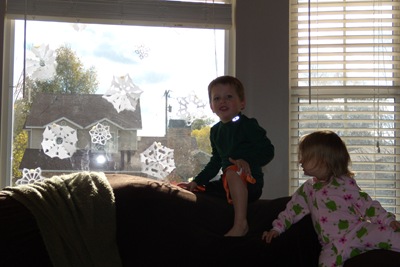
The snow isn’t fully upon us – yet – but in honor of the imminent snowy weather, we made snowflakes to hang on the front window. (Don’t let the sunshine and Little Einstein’s shorts fool you – I believe it was between 30-40 degrees that day). We listed to Janeen Brady’s Dainty Little Snowflakes and used the guide for making snowflakes out of her book.

DSCN4086Making snowflakes is a great activity to do with your kids – they love scissors, right? Mine do. The kid scissors had a hard time cutting through all the layers of paper, but as long as I was helping, it went fine. And look at those gorgeous snowflakes! (please ignore the dirty window...)DSCN4090

Teaching your kids safe scissor skills is probably one of the best things you can do. I mean, really, who wants their kids cutting their hair (or their sister’s hair! Heaven forbid...) 
   

DSCN4089
Little E and Baby E proudly displaying their artwork. And just in time. Saturday night we got nearly a foot of snow, and apparently there is more in store for us! We’ll have to do some more fun snow-themed projects. Of course, there’s also Thanksgiving projects to do this week. The snow will last all season.

Do your kids get to play in the snow in the winter time? Or do you have more mild weather? What kinds of winter activities do you do?

Monday, September 13, 2010

Guest Post

Not by who you would think. This guest post is by Little Einstein. As part of our play-based preschool, we are encouraging Little Einstein to dictate to us so we can type. He doesn’t know how to write or read, but I believe encouraging him to let me write down things he dictates to me will encourage a desire to learn to read and write.Picture 12 “There’s lizards everywhere in the house. She’s got blue and green and there’s all that colors on that lizard. I like putting him in the basket so she can swim. I put my lizard in the basket and she can swim.”

Well, that went okay. It’s a work in progress, and a three-year-old’s attention span is limited, but we got a lot of creativity out of it! when I asked Little Einstein to tell me about his lizard, he told me that he wanted me to put a picture of the lizard on the blog, so we whipped out the webcam and now you have a picture of one of L.E.’s most prized possessions – his lizard. Then he started singing and dancing (which I should have caught on the webcam for this post, but didn’t – next time!). Then he didn’t really want to talk about the lizard because he had already danced and put a picture on the blog.

We haven’t done this in a while due to a move, but we’re picking back up on things now, so hopefully his ... stories ... will get a little more interesting. (as if they aren’t already!)

We’re headed to the library tomorrow for story time, and hopefully we’ll be able to get a library card, even though we’re only going to be here for a month. This summer has been the worst for us for library time due to some family emergencies.

Reading time is coming back full force! (we would be reading without the library – since we have a huge collection of classic children’s books, but they are all stored for the summer while we’re “in between houses” – we only have two or three with us, but the library fills in the gaps for us.

Saturday, June 5, 2010

In Defense of Five Year Olds

My mother and I have been going through a bunch of her old papers – trying to scan what’s useful into the computers, and recycling what’s not.

Mom was an elementary school teacher, and is well-read in early childhood education, as well as child development.

As we were going through her papers, we found an article distributed by Frederick J. Moffit, Chief Bureau of Instructional Supervision, New York Department of Education. It was taken from the Association for Childhood Education in February 1946.

Sounds a little outdated, sure – but I agree with the viewpoint. Since I looked all over the web to find a link to this article, or book that contained this article, or ANYTHING, but found nothing, I figure I’ll post the whole article it it’s entirety – with accurate, and hopefully sufficient credit to the publisher – and if someone has a problem, I’m sure they’ll email me and tell me to take it down. Otherwise, I find this piece of writing to be very valuable, and I think more people should read it!

IN DEFENSE OF FIVE-YEAR OLDS

Studies of children show us that three basic needs of each individual are to be competent, secure and active. Experience which meet these needs for a two-year-old would not be satisfactory in terms of specific situations for five-year-olds, not would the five-year-old experiences satisfy children of ten, although for all ages the general basic needs remain constant. This is not to say that children should be considered in terms of age levels, because in some respects a five-year-old may behave like a child of three, of five or of eight years of age. There are, however, certain general experiences that five-year-olds must have if their basic needs are to be met. These needs are fundamental considerations in planning their educational program

FIVE YEAR OLDS SHOULD HAVE PLENT OF OPPORTUNITY TO climb, to run and to carry on group construction projects outdoors with large boxes, kegs, boards and the like. These activities will contribute to the development of large muscle coordination. At the same time, these children like to experiment with small muscle activity in the use of paint, clay or crayons. But such activities as sewing, reading and writing demand too concentrated use of eyes and small muscles, which often results in tensions and impairments.

THESE CHILDREN SHOULD HAVE ALTERNATE PERIODS of quiet and active work and should not be expected to sit still for long periods of time. Nor should they all be expected to do the same thing at the same time, especially when the thing undertaken has no meaning to them, does not meet their fundamental needs and is entirely teacher initiated and directed. The fives are exposed to such harmful situations when they are placed in first grades as usually organized or when they are expected to do first grade work in so-called pre-primary classes. They are not ready for these experiences in their muscles, their minds or their feelings. Superimposing the academic pattern upon them gives them experience with failure and frustration early in their school career. There is no surer way of making hostile, aggressive, with-drawn or tense children. All of these behavior manifestations characterize the maladjusted, incompetent,  insecure child and adult.

Five-year-olds have a wide-ranging curiousity about the world of things and of people in which and with whom they live. To discover the ways materials behave and feel and to learn the skills in controlling them is an exciting challenge to these children. To find ways of playing with one another, to try out each other’s abilities and qualities, to learn success and to make mistakes as individuals and as groups through dramatic play are all vital daily experiences for five-year-old children.

In the traditional first grade such interests are taboo, frowned upon and sternly eliminated. So the child’s curiosity soon vanishes to be utilized only out of school. The give and take with his peers without which social development cannot take place is impossible in a classroom where contacts with other children are prohibited by the furniture, the teacher, and the kind of work to be done. He is again rendered insecure and incompetent with no opportunity for or guidance in gaining skill in satisfying his curiosity or in getting along with others. In addition, where contacts are with the teacher only and not with other children, warped ways of getting on with adults develop. Individual children vie with one another for adult attention and approval, and tattling, fighting, slyness, shrinking timidity and similar harmful behavior appears. The “teacher’s pet” characterizes every classroom as is often snowballed or pounced upon as soon as the school grounds are left behind.

TODAY WE FACE A SERIOUS PROBLEM affecting the five-year-olds. The pressures of administrative convenience, the lure of newly appropriated funds, and the widespread public demand for educational opportunities for the five-year-olds are precipitating the environment appropriate for them. The time has come for the teachers and parents to band together to stop this disastrous practice if the five-year-olds are to have safe, happy and active lives at school.

Taken from ASSOCIATION FOR CHILDHOOD EDUCATION February 1946

I think that I have nearly been sucked into thinking that my three year old should have these kinds of “academic” experiences! No! He needs to run and play and construct, and learn to interact FREELY with other children, without having me interfere and initiate and run his education.

The thing about little children is that they learn what’s in front of them. You don’t need to do a lot of “teaching” – which is nice, because they probably won’t sit still long enough anyway! So we need to simply let them learn.

It’s great to surround them with things to learn – for example, I used to take V to the aquarium all the time – once a month, at least! He has learned all sorts of fascinating things about ocean and marine life. Without having to ever sit in a desk and listen to a teacher.

He has learned a lot about plants, animals, the outdoors – without ever having to do a worksheet, or even read a book.

We experience life. We learn through play.

And that’s what this blog is about – learning through play.

I hope you will join me on this adventure as I learn with my children – and especially as I learn how to play again!